
Epoxy or Painted Concrete for a Garage Floor
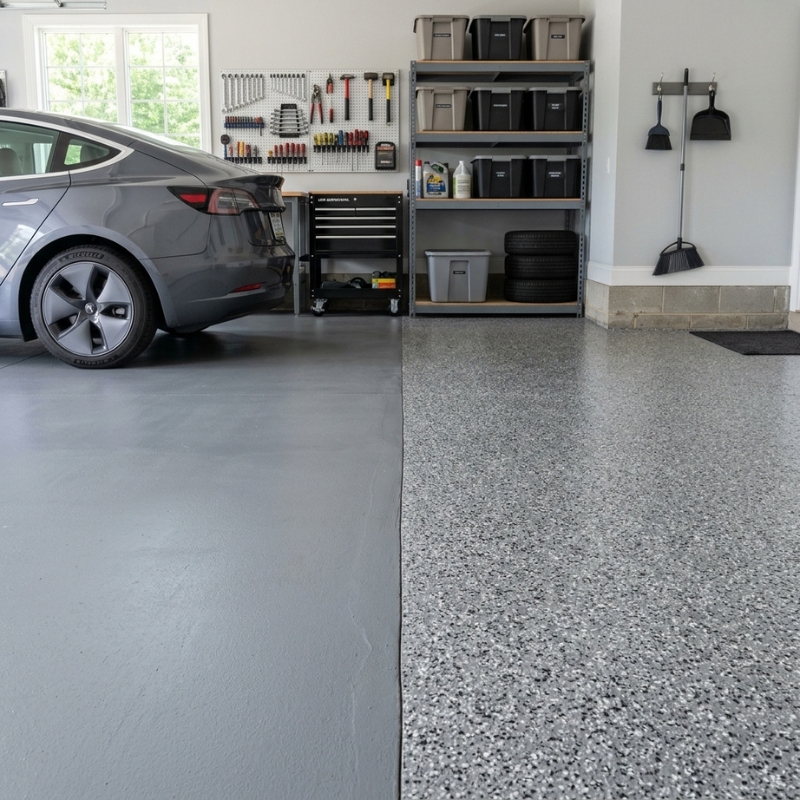
Garage floors are asked to do a lot. They take vehicle weight, dropped tools, spilled oil and the heat off tyres that have just come off the motorway. So when the slab starts looking tired, the question is usually the same one: is a tin of concrete floor paint enough, or is this a job for a proper epoxy system?
This is a real comparison, not a push towards the more expensive option. Both have a place. The honest answer depends on what the space is actually used for, what condition the slab is in, and how much preparation you are willing to do or pay for. Here is what each one is, how they differ in practice, and which suits which situation.
Concrete paint is a surface coating that sits on the slab, so tyres and oil work at it from the surface down. Epoxy is a bonded system ground into prepared concrete, so it resists traffic, chemicals and hot tyre pick-up differently rather than simply better. The preparation is the real difference, and it is what decides how either one lasts.
What concrete floor paint actually is
Concrete floor paint is a coating that sits on top of the slab, applied much the same way as any other paint. Most are single pack acrylic or solvent based products made for masonry, and some are two pack formulations sold specifically for garage use.
The process is familiar. The slab is cleaned and degreased, usually etched with an acid wash to take the sheen off the surface, cracks and holes are filled, and the paint goes on by roller or brush in two or more coats, with the time between coats set by the manufacturer's technical data sheet.
It is a straightforward job, and that is much of its appeal. A tidy slab in reasonable condition can be rolled out over a weekend. The finish is a solid colour, it seals down a dusty floor, it is easy to touch up, and it can be recoated later without taking everything back to bare concrete.
The thing to understand is where the coating lives. It bonds to the surface layer of the slab, so whatever that surface layer is doing, the paint does with it.
What an epoxy coating system is
An epoxy coating is not a paint but a bonded, multi layer system: the concrete is mechanically ground, then a primer, a build coat and a sealer go down over it as one build.
It starts with the grinder. A diamond grinder takes the top layer off the slab, removing laitance, old coatings, sealers and surface contamination and leaving an open, textured profile. Holes, cracks and joints are then repaired with a patching compound compatible with the system going over them.
A primer goes down first and soaks into the open concrete. The build coat follows, a two pack resin and hardener mixed on site and spread to a set thickness, and that is where the colour comes from.
At this point you choose the finish. A solid colour build coat gives a smooth, even floor. A flake system has vinyl chips broadcast into the wet coat, scraped back once cured and then sealed, which gives a speckled surface with some texture underfoot and a look that carries minor imperfections well.
A clear sealer goes over the top, and a non slip additive can be mixed through it where the floor is likely to get wet.
The whole build cures chemically rather than drying by evaporation, so the times between steps are driven by temperature and by the product's technical data sheet, not simply by how long the floor has been left alone.
What grinding does that cleaning does not
Grinding and cleaning leave the slab in two different states, and that is the core of the difference between the two approaches.
Cleaning and acid etching work on the surface. Degreasing lifts contamination, and an etch reacts with the top of the slab to roughen it and take the sheen off. What is left afterwards is the original surface, opened up a little, with the laitance, the weak, fine layer that rises to the top as concrete is finished, largely still in place. Any old coating stays where it is unless it is stripped separately.
Mechanical grinding removes material. The diamonds cut the laitance away and take the slab back to sound concrete, exposing the aggregate and leaving a measurable profile of peaks and valleys. Old coatings, sealers and embedded contamination come off with it.
A bonded system is specified against that profile. Epoxy keys into the texture and into the pores of the concrete underneath, which is why a data sheet calls for a prepared surface rather than simply a clean one. A coating that sits on the surface is working with whatever that surface happens to be.
How the two compare in a Sydney garage
Set side by side, the two differ most in how the slab is prepared and in how each one is applied, repaired and finished.
| Concrete floor paint | Epoxy coating system | |
|---|---|---|
| How the slab is prepared | Cleaned, degreased and acid etched or lightly abraded. Any existing coating is stripped separately if it is coming off at all. | Diamond ground back to sound concrete, taking off laitance, old coatings and sealers, then cracks, holes and joints repaired. |
| How it is applied | Rolled or brushed on in two or more coats, with the time between coats set by the data sheet. | Primer, then a two pack build coat mixed on site and spread to a set thickness, flake broadcast if used, then a clear sealer. |
| How it is repaired or recoated | Touched up or recoated over the existing paint after cleaning and light abrasion. | Recoated over the sealer after mechanical abrasion. A damaged area is ground out and rebuilt as a patch. |
| How it looks finished | Solid colour, smooth, close to the texture of the slab underneath. | Solid colour or flake. Flake gives a speckled finish with texture underfoot under a clear sealed surface. |
Where painted concrete is the sensible choice
Painted concrete is the sensible choice where the floor is not doing much work.
A garden shed, a storage garage that holds boxes and a bike, a laundry, a granny flat floor or the space under a house all see foot traffic and not much else. Paint tidies them up, seals the dust down and takes a weekend.
It also makes sense as a holding move. If the slab is due to be replaced, if the garage is being reconfigured in a year or two, or if you are getting a property ready for sale and want the floor presentable, a coating does that job without committing to the preparation a bonded system needs.
And it suits owners who want to do the work themselves. The materials are on the shelf at any trade or hardware supplier, the tools are a roller and a brush, and the skill is in the preparation and in following the data sheet on coats and recoat times.
Where epoxy earns its place
Epoxy earns its place in spaces that get used every day and have to work and look like a proper floor.
A garage a car goes in and out of daily is the most common case. So is a home workshop with a bench, a hoist or machinery, where tools get dropped, fluids get spilled and the floor is swept and hosed down regularly. Flake finishes are popular here because the texture is forgiving underfoot and the speckle does not show every mark.
Showrooms, display garages and enthusiasts' spaces sit at the other end of it, where the floor is part of how the space presents and a seamless, sealed finish matters.
Commercial and industrial spaces run on the same thinking at a larger scale. Factory floors, warehouse aisles, workshops and plant rooms get coated as systems rather than painted, often at the same time as the walls and structure as part of a broader industrial and warehouse painting job.
If you are not sure which side of the line your garage sits on, the honest test is how often you use it and what you do in there.
Signs your existing floor coating is failing
A failing floor coating announces itself in a handful of ways, and most of them are visible from the doorway.
- Peeling or lifting along the door line, where the slab gets wet, hot and cold and takes the most traffic
- Tyre marks that lift the surface rather than just mark it, usually where a warm tyre has sat in the same spot
- Patches going chalky or powdery underfoot and leaving dust on your shoes
- Flaking around drains, floor wastes and anywhere water pools
- Bubbles or blisters, which generally point to moisture coming up through the slab
- Colour worn back to bare concrete along the wheel tracks
Any of these mean the coating has lost its grip on the slab somewhere. Patching over the top does not address that, because a new coating can only hold on as well as whatever is under it.
Match the system to the use and the decision gets much easier. A low traffic shed or a storage space does not need a ground and bonded floor, and painting it is a sensible, honest choice. A garage you use every day, a working workshop or a space that has to present well is asking for something built as a system.
Whichever way you go, do not skip the preparation. It is the part that decides the outcome, and it is most of the work in either case. If you want the floor assessed before deciding, our epoxy flooring service page explains how we prepare and lay it.
Frequently asked questions
Can epoxy be applied straight over old garage floor paint?
Usually not. Epoxy bonds to prepared concrete rather than to another coating, so existing paint normally has to be mechanically removed first. Leaving it underneath is one of the most common causes of a new floor failing, because the system can only hold as well as the layer beneath it.
Does an epoxy garage floor get slippery when wet?
It can, as any sealed surface can, which is why a non slip additive is mixed through the sealer where the floor is likely to get wet. Flake systems also leave a slight texture underfoot once sealed. Ask for the additive if the garage gets hosed out or takes wet cars.
Get a free quote
For a fixed-price quote, call Sydney Paintmasters on 0423 019 087 or request your free quote online.